With the exception of bildungsroman tales, however, there is no reason the age must be adolescent or the struggles pubescent when we invoke the phrase “coming of age”. After all, rites of passage (eg, graduations, first jobs, parental loss) can occur at many different ages.
Literary Connections
In one of those fascinating moments of literary connection, I stumbled upon a quote that resonated with my own writing:[*]
I discovered this statement, attributed to Antonya Nelson (author of Female Trouble), in a Q/A session between Karen Russell (author of Swamplandia and interviewer) and Robin Black (the interviewee) that served as an afterwords for Black’s short story collection, If I Loved You, I Would Tell You This: Stories. Russell references Nelson’s remark while discussing Black’s stories, which she notes explore with intensity how characters “come of age” at various points of their life. Concurring, Black relates her view that “coming-of-age” stories are works involving the change from innocence to experience, a process that continues to complicate one’s life. I found myself nodding, as my story-in-progress sprang to mind.
Coming of Ages
But what does a “coming of age” story represent? Usually, we refer to stories focusing on a young person in the process of achieving adulthood. Examples range from a teenager gaining understanding of her mother and harm seen in Nelson’s short story “Primum Non Nocere” to bildungsroman novels (eg, The History of Tom Jones by Henry Fielding), which focus on the development of a youth into maturity (eg, moral, psychological, intellectual).[‡] With the exception of bildungsroman tales,[§] however, there is no reason the age must be adolescent or the struggles pubescent when we invoke the phrase “coming of age”. After all, rites of passage (eg, graduations, first jobs, parental loss) occur at many different ages.
In my intergenerational story, three women’s lives change, with each experiencing a “coming of their particular age”. The youngest member, of course, experiences the more typical coming-of-age moment after leaving college. For her mother, her child’s nascent adulthood revives memories of her own mistakes at that age coupled with current worries that make it difficult for her to accept her child’s choices. And for the grandmother of the group? In addition to supporting the younger women in different ways, she looks toward her own next transition: addressing her own increasingly limited ability to care for herself.
Characterizing Maturation
One of the reasons I’ve enjoyed working with this story is that I felt the characters had opportunities to grow and learn, either by succeeding in their endeavors or by failing. When I read this interview and considered “coming of ages” in my writing, I knew I’d stumbled onto an underlying theme of my story: how families deal with their continuing evolution. In this regard, I felt more kinship with Black’s notion of moving from innocence to experience. Or, as I think of it, the ways in which we move from ignorance to knowledge, learning how to be ourselves at a certain age. It’s worth considering how characters of all ages “come of age”, how they mature through their experiences, when we write. Maturity, as Black notes, may not confer mastery but it makes for a richer tale.
[†] “A Reader’s Guide.” Black, Robin. Interview by Karen Russell. In: Black, Robin. If I Loved You, I Would Tell You This: Stories. New York, Random House, 2011.
[‡] Anne Boyd Rioux discusses female bildungsroman novels, including the contradictory nature of applying this term to female protagonists when such characters ultimately step into their expected social roles instead of pursuing their own dreams. Fortunately, she also lists several nineteenth century novels that flout these limitations here.
Insight into the motivations of some villains, however, can be the crucial difference between producing a caricature and a badly flawed individual.
Kurt Vonnegut’s rules for writing good short stories state that all characters “should want something, even if it is only a glass of water”.[*] Vonnegut’s levity aside, considering what fictional characters desire is useful because such explorations often reveals their underlying motivation, particularly when we write about antagonists. Antagonists represent individuals who oppose protagonists in some fashion. With exceptions such as monsters or forces of nature, most antagonists have reasons for their opposition. When writers understand what motivates their antagonist’s decisions to block the protagonist, we can root their subsequent actions within that frame of reference, thus giving their behavior an explicable context.
Villainous Pathos and Madness
When discussing antagonists, we often think of outright villains. It’s often easy to discover what motivates these villains to thwart a (presumably) plucky protagonist. The criminal masterminds and “take over the world types”, for example, have clear goals. Further insight into the motivations of some villains, however, can be the crucial difference between producing a caricature and a badly flawed individual. Consider J. K. Rowling’s Voldemort, whose snake-like appearance and (temporarily) undying nature makes him monstrous, more embodiment of evil than wicked wizard. As we discover in Harry Potter and the Half-Blood Prince, Voldemort fears death and considers it to be a shameful weakness. Because he desires immortality, Voldemort chooses to undergo dangerous, immoral magical rituals.[†] Discovering that Voldemort’s behavior is motivated by his boyhood fears, initially stemming from the mistaken belief that his mother couldn’t be magical because she died and left him alone, both explains his reprehensible choices and humanizes him. Thus, learning Voldemort’s motivations provokes a twinge of pity for the person he might’ve become under different circumstances.
With other villains, gaining an understanding of what motivates these villains not only explains why these characters act as they do but also assists protagonists in overcoming the obstacles the villains set and/or defeat them. In Stephen King’s novel Misery, a seriously injured Paul Sheldon is held captive by Annie Wilkes. Understanding both Annie’s volatile mental status[‡] and her obsession with his Misery Chastain novels, he concocts a desperate plan to escape before she kills them both. Once he completes the Misery novel that Wilkes forced him to write, he ignites it instead of letting her read it. Caught off guard and desperate to save the book, she approaches close enough for Sheldon to attack and then lock himself away while he waits for the police.
Annie Wilkes’s short-term motivation involved murdering Paul Sheldon with a chainsaw, had she survived her injuries.
Law and Laughs: Adversaries and Friendly Obstructionists
Many antagonists, however, lack a villainous streak. Victor Hugo’s indefatigable policeman from Les Miserables spends his time enforcing the law he when isn’t attempting to recapture fugitive petty thief and protagonist, Jean Valjean. Javert’s relentless pursuit of Valjean seems excessive when considering the nature of crimes Valjean committed (bread theft). However, Javert is not interested in the unfairness of human law (or its sentencing) so much as he is passionate about enforcing it. He possesses a rigid worldview that despises challenges to authority and social order; he also does not believe lawbreakers like Valjean are capable of reform. Compelled to set affronts to order right, Javert also derives immense pleasure from doing so. Understanding Javert’s code explains both his conduct and prepares us for his fate. Although forced to flee Javert for years, Jean Valjean saves his long-time nemesis’s life—something which Javert finds incomprehensible. Once confident in his role in the world, Javert’s value system is upturned, prompting him to do something that otherwise would be unthinkable for such a man: he commits suicide.
In other instances, the non-villainous antagonist are less adversaries and more well-meaning sorts who nonetheless creates difficulties for protagonists. Agatha Christie has a beloved family member juggle the roles of benefactor and antagonist in her short story “Strange Jest.” Recently deceased Uncle Matthew hid a fortune for his two heirs to find. Despite their diligent searching, they find nothing. Frustrated, they agree to let Miss Marple assist them. Miss Marple seems to be an unlikely sleuth but soon proves to be adept at recognizing types of people and what motivates them. Not long after poking around the deceased’s home, Miss Marple forms the opinion that Matthew is like her own Uncle Henry, a bachelor unaccustomed to children but who enjoyed teasing them. This combination means that he’s likely to go a bit far with his little jokes. As such, the fortune he left is not the gold bullion he suggested burying in the yard instead of placing in a bank (a decoy, according to Miss M), but rare stamps on envelopes accompanying fake love letters that Uncle Matthew likely laughed over while penning—the sort of letters his nephew might’ve burned out of gentlemanly respect for his uncle’s privacy! Understanding that Uncle Matthew couldn’t resist one last joke, however, saved the inheritance.
Uncle Matthew’s desire to have one last joke on his heirs results in digging up the back garden for hidden treasure. Naturally, the inheritance is found in the house.Part of creating a believable character can involve providing them with motivation (rational or not) for what they do. Motivation, working as a component of character behavior, makes characters more realistic. While gaining an understanding of what an antagonist wants might not make them beloved, it does make them relatable and occasionally worthy of readerly sympathy. After all, we all possess aspirations, even ignoble ones.
What motivates your favorite fictional characters? Share in the comment section below! Also, sign up to the Sequence newsletter to stay current with the latest posts.
NOTES:
[*] As mentioned in my post on writing advice, Vonnegut’s list represents specific writing advice that’s helpful to consider as needed.
[†] Undergoing these rituals also cause the radical alteration in his appearance from handsome man to snake-like, thus suggesting his wicked deeds in some way lessen his humanity.
[‡] During previous escape attempts, he discovers that she’s killed in the past (Annie likely has Munchhausen by Proxy syndrome) in addition to murdering a sheriff looking for him.
Although weather may properly be considered part of the setting, both its ubiquitous effects and changeable nature allows it to extend into plot, characterization and more.
Of late, I’ve been thinking about weather. Being informed about the weather is useful for selecting appropriate outerwear and activities. It even provides us with something to discuss about when we greet people. But when weather appears in fiction (either as exposition or dialogue), it exists to accomplish certain narrative goals. Although weather may properly be considered part of the setting, both its ubiquitous effects and changeable nature allows it to influence plot, characterization and more. In the following, I discuss several selections that demonstrates weather’s versatility in fiction.
Plotting Weather
Weather’s pervasiveness and its effect on human lives, of course, is the primary reason it makes an excellent plot device. Stories featuring weather-related catastrophes (from seafaring disasters such as Carol Birch’s Jamrach’s Menagerie to cli-fi dystopias such as Margaret Atwood’s Oryx and Crake) are indebted to the weather for creating their central conflict: survival. These stories frequently rely upon but don’t require epic storms to create a crisis. In Jack London’s short story “To Build a Fire”, harsh winter conditions are normal in the Yukon. The protagonist hikes only with his dog despite warnings to travel in company when it’s dangerously cold. Several mistakes on this frigid day turn this walk into a struggle for life. However, snowfall plays a starring role in creating a very different survival situation in “Three Blind Mice” by Agatha Christie.[†] As forecast by the wireless news, the inhabitants of Monkshood Manor are trapped indoors by a blizzard. Well prepared for the storm, their real difficulty is that one of them is a murderer. However, weather, severe or otherwise, needn’t be life threatening to be a plot point. Although alarming, a tornado’s brief appearance in All the Living by C. E. Morgan merely threatens protagonists Aloma and Orren, reminding them that they need some contact with the world beyond their farm.[‡]
The forecast for Agatha Christie’s “Three Blind Mice” is heavy snow and murder.
Symbolic and Moody Weather
In her article about the role weather plays in literature, Kathryn Schultz discusses how weather went from “mythical to metaphorical”, “with atmospheric conditions…stand[ing] in for the human condition”.[§] Schultz observes that such representations may to refer to individuals, relationships, or societies. Mary Tyrone, a woman suffering from morphine addiction in Eugene O’Neill’s play Long Day’s Journey into Night, declares that she loves the fog because of its ability to conceal the world. Fog, of course, represents the addicted state into which Mary escapes from unpleasant realities such as her son’s illness. The presence of snow in Richard Wright’s novel Native Son, however, works at the societal level. Through much of the novel, Bigger Thomas is surrounded snow, a subtle allusion to how his existence as a black man is circumscribed and controlled by white society.
A foggy night, such as might be seen in Long Day’s Journey into Night.
Symbolic or not, weather in fictional works help authors set the mood. How a writer characterizes the weather in a fictional account will dictate the reader’s emotional response. In the opening lines of “The Story-Teller”, we’re told it’s a “hot afternoon” and that “the railway carriage was correspondingly sultry” (129).[**] Already, readers feel the wearying, perhaps irritable quality of this journey even before we learn that the “unsympathetic” bachelor will share an hour’s train ride with three boisterous children and their aunt, a woman who is ill adept at entertaining her charges (129). Similarly, the fog symbolizing Mary’s addiction in Long Day’s Journey also establishes an atmosphere of tension early in the play. Mary remarks that that the foghorn’s warnings kept her awake and unsettled her nerves. Yet, her family (particularly son Jamie) are all too aware that such restlessness is a symptom of her drug use and check for signs of addiction, something which makes her self-conscious and more nervous.
Scrying the skies for portents of poor weather to modern weather forecasts are among the numerous ways humanity has attempted to tell the future of weather. Yet weather, often working in conjunction with mood, can hint at events to come in fiction. In The Great Gatsby,[‡‡] the warm breeze fills Nick with “the familiar conviction that life was beginning over again with the summer” (8). Nick’s reflection suggests renewal is in the offing: Nick will reacquaint himself with Daisy and Tom just as Gatsby will restart his love affair with Daisy. In a different vein, Zora Neale Hurston presages a devastating hurricane in Their Eyes Were Watching God with several events, among them an animal exodus and the uncanny stillness of the wind. Many, Janie and Tea Cake among them, choose to remain because they think the storm will not be severe. Before he leaves, ‘Lias attempts to persuade the couple to accompany him by stating “dis muck is too low and dat big lake is liable tuh bust” (148).[§§] As predicted, the lake floods, forcing everyone remaining to flee to high ground.
In Their Eyes Were Watching God, a hurricane (likely more severe than this particular storm) devastates Florida.
Characteristic Weather
Using meteorological metaphors, as discussed in Schultz’s article, provides information about characters, ranging from physical characteristics to personality traits (replying icily, for example, uses weather to indicate displeasure). Conversations about weather also can reveal information about characters. In Robert Frost’s narrative poem, “Home Burial”,[†††] clashing notions of appropriate grieving coupled with an offhand remark about weather precipitate a rupture. The husband’s clumsy attempts to speak of their dead child infuriates his wife, particularly when he suggests she overly grieves. Infuriated, Amy accuses him of lacking feeling, given how casually (to her mind) he dug the child’s grave (ln71–78) and discussed his “every day concerns” (ln 86):
‘Three foggy mornings and one rainy morning
Will rot the best birch fence a man can build.’
Think of it, talk like that at such a time!
What had how long it takes a birch to rot
To do with what was in the darkened parlor?
You couldn’t care….(ln 92–7)
One can almost hear the door slam at the poem’s close.
Drawing from Weather
Weather’s profound effect on humanity is evident when we examine literary works. Beyond its humble role in the setting, it pervades mood, portrays us, and even “plots” against us, just as it does in real life. Utilized wisely, fictional weather helps underscore the thrust of a writer’s story, adding depth and complexity. And that makes weather a dynamic literary device.
What is your favorite example of literary weather? Share it in the comment section below.
[†] This short story was based on the radio broadcast of the same name. Ultimately, Christie transformed the radio play into the famous West End play, The Mousetrap. Familiarity with either play or story will work for this example.
[§] Pathetic fallacy, that is attributing human emotion to inanimate objects in nature, often wears the guise of weather in literature.
[**] Saki. The Best of Saki. London: Penguin Popular Classics, 1994.
[††] I could argue that the hardworking fog in Long Day’s Journey (or at least the foghorn) also foreshadows Mary’s relapse. But, I thought I’d reward this example with the rest of the day off, since it’d already done so much.
[‡‡] Fitzgerald, F. Scott. The Great Gatsby. Cambridge: Cambridge U Press, 1991.
[§§] Hurston, Zora Neale. Their Eyes Were Watching God. New York: Harper & Row, 1990.
[†††] Frost, Robert. Robert Frost: Poetry and Prose. New York: Henry Holt, 1984.
Brevity is the soul of wit.[*] (Polonius, Hamlet, Act 2, Scene 2, line 92)—William Shakespeare
Perhaps it’s winter’s elision into Spring, but I feel like it’s time for change, to experiment (a bit) with my writing here at the Sequence. Of late, several posts I’ve written here appear to run on the longer side. While I’ve enjoyed much of what I’ve written, I feel the need for some variation.
Something of a palate cleanser, if you will.
I don’t suggest that terser writing is some sort of literary sorbet. Hemingway, a master of succinct writing, has a short story collection entitled Winner Takes Nothing that neatly summarizes his far from sweet oeuvre.[†] Rather, I’m looking to pare down my writing a bit, try new writing styles, and perhaps write more efficiently. Few writers think they have enough writing time, and I’m no different. It’s this latter goal, working on finding more writing time, that inspired this post. So, here’s my plan for…
…Writing Succinctly to Accomplish More
(1) Short Changing My Words
Recently, I expressed my interest in writing shorter pieces to a friend, and she suggested flash fiction. I haven’t tried flash fiction yet, but the imposed word count (under 1000 words) felt inspiring. Having studied formal poetry, one salient revelation was that restrictions can provoke creativity.[‡] While a word count might seem arbitrary, it requires writers to produce leaner prose while limiting scenes, characters, and action. And similar restrictions could be applied to nonfiction—especially when paired with short-format nonfiction such as the listicle.[§] Choosing a word count, then, could produce sharp, focused writing.
(2) Research Is Revealing
Like many people who blog, I schedule my topics, alternating among my different interests. What I don’t do, however, is plan topics by their development time. If I think a topic needs more research or isn’t “gelled” enough, I move it to a later point. However, I find that my posts often run longer than expected, seeping into time I allotted for other writing projects. And writing several long pieces in a row places more strain on my time to develop future posts. I plan to keep writing posts I enjoy, but I believe that alternating between longer and shorter post can afford both variety and extra writing time for longer works.
So, I checked my word counts and confirmed that my longer pieces (on average, 1300 words) matched my perception of taking longer to write and often longer than estimated. These topics (literary themes, book reviews, etc.) required extensive development in terms of notetaking or research. Yet, my shorter posts, which focused more on personal experiences (usually reading), also happened to be time consuming. My impression that word count and time spent writing were in a proportional relationship wasn’t the whole story. While I had some insight into better scheduling, I needed to investigate my process further.
(3) Structuring My Writing Process—Just a Bit!
I tend to discover my text instead of planning it (ie, I compose at the computer). Typically, my pre-writing is minimal, often involving relevant research and jotting my ideas down. For example, I devoted significant effort to discussing an author’s approach to the orphaned main character trope for a recent book review, something I found interesting but didn’t give readers the flavor of book. Of course, I cut this section, but using an outline might have prevented the need to do so. Outlining also visually demonstrates how lengthy a topic is by the number of points present, giving a rough estimate of writing time needed. Of course, revisions—extensive or not[**]—will occur. Likewise, I expect much of writing will be unplanned.[††] I hope, though, that having a blueprint for my writing in mind will keep from diverting into unnecessary asides.
Off to Write
My course from here is clear: to apply lessons learned. To my surprise, a little writerly navel gazing has proved to be inspiring. I’m looking forward to trying out these ideas (particularly flash fiction), and I’m pleased that I set my first word count (775 words; I finished near 830). Next up, scheduling and outlining the next Sequence. So, if you’ll excuse me, I have some pre-writing to do.
What approaches have you tried for improving your writing? Add your response to the comment box below. Also, sign up to the Sequence newsletter and stay up-to-date with the latest posts.
NOTES:
[*] Polonius adds this quip after a longwinded discussion of wasting time.
[†] Or, as my friends and I joked more than once, his stories were about “Dying alone. In the rain.”
Don’t take anyone’s writing advice too seriously.—Lev Grossman
On a regular basis, somewhere in my social media streams, I find the flotsam of writing advice swirling amidst other writing topics, inspirational quotes, and the obligatory cat photos. For this post, I decided to wade in and see what I could learn from what was available. I trawled Twitter, Facebook, and Goodreads. Then, I performed internet searches just to make sure I’d gotten a good sense of what’s available.
Solid Suggestions
Much of what we’re advised about writing seems familiar after a few quotes. We should submerge ourselves in reading—read often and widely, particularly the works of celebrated authors and works beyond our own genre preferences. We need to actually write, write regularly, finish writing that piece, and submit our work for publication. It’s solid advice[*] that many repeat in their own way, so much so that it seems like an ever-expanding ripple in a pond. Here are few great variations on a theme:
If you don’t have time to read, you don’t have the time (or the tools) to write. Simple as that. —Stephen King
Read all the time and keep writing. There are a million talented writers out there who are unpublished only because they stop writing when it gets hard. Don’t do that—keep writing. —Gillian Flynn
To be a successful fiction writer you have to write well, write a lot … and let ‘em know you’ve written it! Then rinse and repeat. —Gerard de Marigny
In writing, habit seems to be a much stronger force than either willpower or inspiration. Consequently there must be some little quality of fierceness until the habit pattern of a certain number of words is established. —John Steinbeck
People say to write about what you know. I’m here to tell you, no one wants to read that, cos you don’t know anything. So write about something you don’t know. And don’t be scared, ever.
The more specific writing advice gets, the more disagreements emerge. Here are four exemplary writing rules many of us have encountered at one point:
Show, don’t tell
Avoid adverbs and adjectives
Write what you know
Vary word choice
To understand the source of this discord, it’s useful to examine one so-called rule more closely: show versus tell. Mary Robinette Kowal indicates that showing “mostly applies to your character’s internal life, emotions and physical sensation,” when telling would prevent the reader from sharing in the character’s feelings and sensations. However, Susan Defreitas argues that “hot tears, a pounding pulse, and clenched fists can stand in for sadness, fear, and anger. But that…doesn’t actually show what this specific character is specifically feeling… you either have to relay the thought process giving rise to those emotions or you should have already set up some key bits of exposition.”
Similarly, Defreitas observes that this advice causes writers to provide involved character backgrounds when simply stating a few choice details would have accomplished the same effect. To this list, Kowal adds uninteresting action, namely showing every move a character makes (regardless of its relevance) instead of summarizing and (again) achieving the same result. Still Defreitas’s framing this “rule” as bad advice stirs up dissent. Michael Neff states that “I’ve never seen SHOW DON’T TELL as a hard and fast rule that covers all conditions and circumstances. Obviously, one may need to ‘tell’ at such time a certain type of exposition needs to be artfully delivered and dialogue isn’t sufficient.”
Feeling swamped with conflicting messages yet?
Confused by all the conflicting writing advice and so-called rules? Photo by Olya Kobruseva from Pexels.
Having delved into this topic, two things became clear. First, such advice is most often proffered toward beginner writers, something which both Neff and Defreitas acknowledge. Less experienced writers, still learning how to make their writing flow, often tend to be verbose. Second, much like the other bulleted items on my (brief, not exhaustive) list, “show versus tell” suffers from either misapplication or strict over-adherence. Arguably, more novice writers need a more precise understanding of the advice provided, as well as permission to view such suggestions as a guideline to learning how to better self-edit.
For Your Consideration: Personal Preferences, Specific Information, and Context
Yet, some writing advice resists categorization, especially when presented outside its original context. For example, several quotes by Elmore Leonard surfaced in my research, some of which other writers found objectionable.[†] When I specifically searched for his writing advice, I found an article that he wrote for the New York Times. The rules he shares are his take on how he chooses to remain invisible as a writer, something he acknowledges won’t work for all writers. And most of those rules include successful exceptions (albeit from other authors). So, it’s really about his writing aesthetics, which he offers should they prove useful to other writers, even those more visible writers.
Then there are writers whose advice seem to lack mooring without context:
When in doubt, have a man come through the door with a gun in his hand. —Raymond Chandler
Here is a lesson in creative writing. First rule: Do not use semicolons. They are transvestite hermaphrodites representing absolutely nothing. All they do is show you’ve been to college. —Kurt Vonnegut
In Chandler’s case, this isn’t so much writing advice as it was a tactic he resorted to using because of the demand for more action in pulp fiction tales. I suppose it serves more as a literary life saver than an advisable course of action. And then there’s Vonnegut’s opinion on semicolons. While his outlandish metaphor may leave one reeling, his advice reduces to a dislike of semicolons.[‡] As Mignon Fogarty (Grammar Girl) reveals, his advice (when examined in context) is more hyperbole than a strict injunction: after all, Vonnegut uses semicolons in his fiction writing. Avoiding semicolons, however, is a stylistic preference (not a rule) and, as such, can be ignored by those who love their usage. But in Vonnegut’s defense, his colorful advice for writing short stories ranges from his personal preferences, more general advice (eschewing suspense, which of course won’t work for everyone[§]) to specific and rather good information on characterization (such as ensuring that characters want something, “even if it is only a glass of water”). Again, once the context is understood, the writer can decide whether the advice offered is applicable.
Remember: when people tell you something’s wrong or doesn’t work for them, they are almost always right. When they tell you exactly what they think is wrong and how to fix it, they are almost always wrong. ―Neil Gaiman
You never have to change anything you got up in the middle of the night to write. ―Saul Bellow
And the Rest Depends on the Recipient
Much of the remaining advice that I read bridges numerous topics, such as dealing with criticism, the revision process, sources of inspiration, and lifestyle choices for writer—all of which I left unaddressed because I realized that most writing advice (even advice that doesn’t specifically address writing like lifestyle choices[**]) depends on its recipient. And it’s with that I find my conclusion. Unless it’s outright facetious non-advice or literal nonsense, most writing advice has potential to resonate with another writer. Our understanding and application of the advice in question may be imperfect but that doesn’t diminish its value. Writing is highly personal; we won’t all find Leonard’s advice on adverbs useful or Bellow’s revision remarks more than tongue in cheek without a specific context.[††] So where does that leave us? We must think carefully and choose wisely for ourselves. And most importantly:
What’s your favorite writing advice? Share it in the comment section below.
Updated on 4 June 2021: Feature image (cat wrting) is by naobim. Updates include adding a new image (question marks) as well as image attributions for all images. Hyperlink attributes to quotes from Goodread were added. Text (footnotes included) was edited for clarity, concision, and consistency. Finally, the original first two sentences (with their footnotes) were removed, because I never like them anyway.
NOTES:
[*]For example, none of us would be writing without first reading. And if you want to write, sooner or later you must put words on a page.
[†]“Never open a book with weather” makes James Bells’s list of writing advice to ignore, perhaps unfairly as Leonard’s article addresses some of these concerns.
[‡] A preference he shares with Cormac McCarthy. McCarthy also dislikes exclamation marks.
Popova, Maria. “How Steinbeck Used the Diary as a Tool of Discipline, a Hedge Against Self-Doubt, and a Pacemaker for the Heartbeat of Creative Work.” Brain Pickings. N.p., 12 Aug. 2016. Accessed 10 Mar. 2017. https://www.brainpickings.org/2015/03/02/john-steinbeck-working-days/
When it comes to stirring the plot, the familial dining table provides numerous opportunities for writers to use this setting to do as much or as little as they need it to do.
Among the most commonly occurring and underrated settings employed in fiction is the dining table. The dinner table serves more than (hopefully) good eats: it provides both place and reason for characters to be together. Relatively few limits exist for such gatherings. The dinner table accommodates routine meals but also can expand (with a leaf or two) for a holiday party or become several tables at an awards ceremony. Locations also are flexible: I’ve recently set the opening of a story at a patio table during a birthday barbecue. Impromptu celebrations such as promotions, too, might result in an outing to a favorite restaurant. Since mealtimes can occur at any point in the plot, so long as it makes sense for people to eat, the dinner table represents one of the most versatile settings that writers can use to creates scenes, forward the plot, and/or explore the central problem of a story. While these tables can appear in innumerable story types, I will discuss how a few of my favorite authors set the table when writing about families.
Mischief Managed: Rowling’s Kitchen Table
For these stories, setting the action at the dinner table can be quite natural. After all, families often are urged to dine together: shared meals are touted for strengthening familial bonds as well as providing a host of positive benefits. And who wouldn’t want to dine with their loved ones? However, even tight-knit families experience their moments of discord. Featured prominently in the Harry Potter series, the Weasley family is considered a loving one.[*] Harry Potter’s first breakfast at their home, however, is rather tense. Concerned that Harry hadn’t replied to their letters, Ron, Fred, and George Weasley decide to use their father’s enchanted car to rescue Harry from his relations (it was a cloudy night) and sneak him into their home undetected. Unluckily for them, Mrs. Weasley observes both absent boys and car and upbraids all parties for their irresponsibility save the relatively blameless Harry. Mrs. Weasley is somewhat mollified when her sons tell her of Harry’s hardships, but she isn’t one to let them escape having any consequences because their intentions were good: they have chores to do. She sends them outdoors to sort out garden beds before they get the chance to nap. (Rowling 24–41).
Rowling accomplishes quite a lot in these pages besides removing Harry from an unpleasant situation (and thus moving the plot forward). Harry, long accustomed to his aunt’s and uncle’s tendency to condone and excuse his cousin’s bad behavior while punishing him for mere infractions, sees Mrs. Weasley appropriately scold her children for engaging in a risky activity. His subsequent meals at the Burrow, where he is welcomed at the table and in which Mrs. Weasley attempts to feed him up (the Dursleys begrudge him every morsel ), are new experiences for him.[†] Escaping to the Burrow introduces Harry to how loving families work. More telling, though, is the contrast that reader sees between Harry’s home life, which is arguably neater, wealthier, and unhappier (Rowling 1–42). Rowling underscores the point that judging people’s worth by mere appearances or their wealth is fallacious. What makes people worthy is the how they treat each other. It’s little wonder that Harry would rather spend his summers in the happy chaos of the Burrow.
Mystery, Misery and Murder at Christie’s Banquets
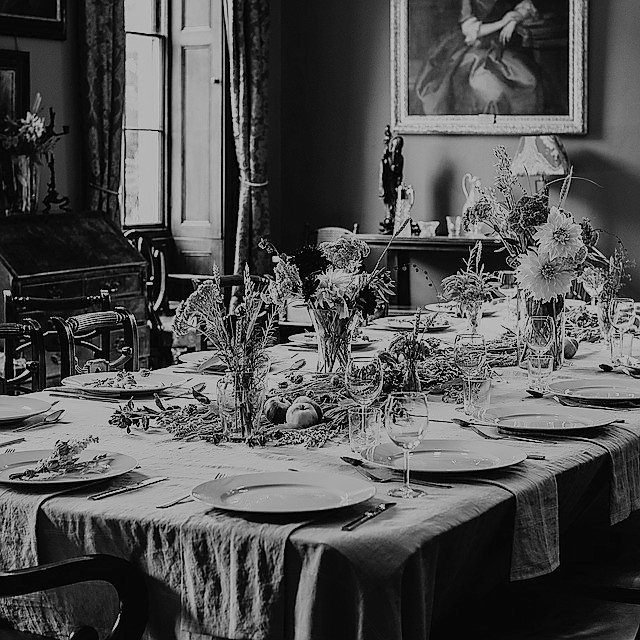
For unhappy families, however, the potential for tension at the table is extensive. Agatha Christie, a master of the manor house mystery, frequently seats her characters at a formal dining table. Since her mystery novels often involve the murder of a wealthy benefactor to various family members (money and resentment making excellent motivations), mealtimes can be quite intense. The dinner table, being an obliging sort,[‡] works as both setting and opportunity for narrative exposition. In “The Second Gong”,[§] dinner guests and family members alike almost race to the dinner table to ensure they arrive punctually because their host, Hubert Lytcham Roche, notoriously despises lateness. His tardiness is so unprecedented that his guests and butler are stunned and hardly know how to proceed. Shortly thereafter, they find Hubert dead. Here, the table works in two ways: it reveals aspects of Hubert’s character (his controlling, unyielding nature) and gathers all the principal suspects together. In A Pocket Full of Rye, however, the dining table serves as the murder scene: Rex Forestcue, a rather nasty man, is poisoned during breakfast whilst surrounded by suspects—er, family members—all of whom had both motive and opportunity to kill him. In novels such as The Mysterious Affair at Styles, Christie uses the dinner table to review the case and acquire background information: Captain Hastings, a guest at Styles Court, and Hercule Poirot discuss the murder of Emily Inglethop during breakfast on at least two occasions, which affords Poirot the opportunity to question persons present about events surrounding the murder (for which he was not present) and gather clues.
Gaiman: What the Monster Made for Dinner
Of course, not every family need be wealthy (or murderous) to be unhappily seated together at the table. From the outset of The Ocean at the End of the Lane, it seems clear that the seven-year-old protagonist’s parents don’t relate to their bookish boy. Neither mentions his kitten’s death after it occurred, not even to offer consolation. The boy doesn’t share his disappointment about receiving the unsuitable replacement cat with them, anticipating (correctly, I suspect) that his parents won’t understand that the hurt remained new cat or not (Gaiman 14–16). During another incident, his older self (who narrates the events) observes that he only consulted adults as a child when he absolutely must (Gaiman 63), suggesting that the boy already expects adults to be reluctant to help him. Understandably Gaiman’s protagonist is terrified when he realizes that his new childminder is an actual monster. He sits at the dinner table on two occasions, hungry but afraid to eat what the monster made for supper (Gaiman 82, 90–92). Beyond their immediate horror, these moments reveal a larger pattern in the novel: the powerlessness of children. It’s all too easy for the monster to portray the boy as truculent, making his protests seem…childish. The boy, already aware of how easy he is to discredit, knows he cannot expect his parents to believe or assist him. Gaiman captures this bitter aspect of childhood, its impotence, and allows it to be the force that drives his narrative by seating a child at a table.
Setting the Table for Family Drama
When it comes to stirring the plot, the familial dining table provides numerous opportunities for writers to use this setting to do as much or as little as they need it to do. It can serve as a mere setting, providing the appropriate backdrop to the story at hand or cleverly reveal information about characters. Often, scenes from a dining table allow writers to connect to larger themes they explore, both for their stories about families and elsewhere. As such, it might not be such a bad idea to set characters down for something to eat and see what happens next.
Do you have a favorite mealtime scene from a story or book? Share what you liked about it in the comment box below. Also, sign up for the Sequence’s newsletter and keep current with the latest posts.
NOTES:
[*] At this point, the Weasley family’s problems lie more with financial constraints and the odd personality clash versus actual deep disagreements with each other.
[†] Harry, much like Jane Eyre before him, represents a tragic form of the poor relation: the orphaned and presumed penniless child required to live under the guardianship of uncaring relations.
[§] For anyone besides me experiencing a bit of literary déjà vu with this story, it’s useful to know that Christie later rewrote and expanded this story, which she called “Dead Man’s Mirror”. I’m working with the original because I like its simpler plot. Having said that, Christie’s work can feel familiar in places because she reuses elements such as nursery rhymes (“Sing a Song of Sixpence” is one I’ve noted in a few stories), themes, and motivations (typically, money).
Works Cited
Christie, Agatha. The Mysterious Affair at Styles: the First Hercule Poirot Novel. New York: Berkley , 1990.
Christie, Agatha. A Pocket Full of Rye. New York: Signet Book, 2000.
Christie, Agatha. “The Second Gong”. Witness for the Prosecution, and Other Stories. New York: Berkley , 1984.
Gaiman, Neil. The Ocean at the End of the Lane. New York, NY: William Morrow, an imprint of HarperCollins Publishers, 2016.
Rowling, J. K. Harry Potter and the Chamber of Secrets. New York: Arthur A. Levine , an imprint of Scholastic Press, 1999.
There should be a limit to one’s ability to feel embarrassed by juvenilia and other potentially cringe-worthy work. Like that first poem I wrote and work shopped, if it still existed anywhere.[*] And yet early efforts in some ways, whether they subsist only in one’s memory or in actual, viewable format, possess a certain strength in their imperfection—something I’ve recently discovered by reminiscing other artistic endeavors:
I vividly remember my first camera, how it felt: the textured red plastic case with the smooth black cord I now would call a wristlet strap.[†] Its rectangular flash stick—my camera didn’t take cubes, which I felt were far cooler. I was ten or thereabouts. I kept most photos, even bad ones, in an album that had sticky pages with plastic covers. With age, the glue became visible wherever photos weren’t. Somewhere along the line, I learned about acidic (not archival) paper. I did not necessarily become better at photo taking.
By high school/college, I switched the photos to an album now called a scrapbook. It had manila pages and clear photo corners, which I found disappointing. I thought the pages and corners would be black, like the scrapbooks of yore, the kind my grandparents remembered from their youth. Removing the old photos proved to be challenging. They’d peel and tear on occasion, the cantankerous, yellowed glue refusing to graciously cede its grip. This time, I added some captions, school awards, and the like.
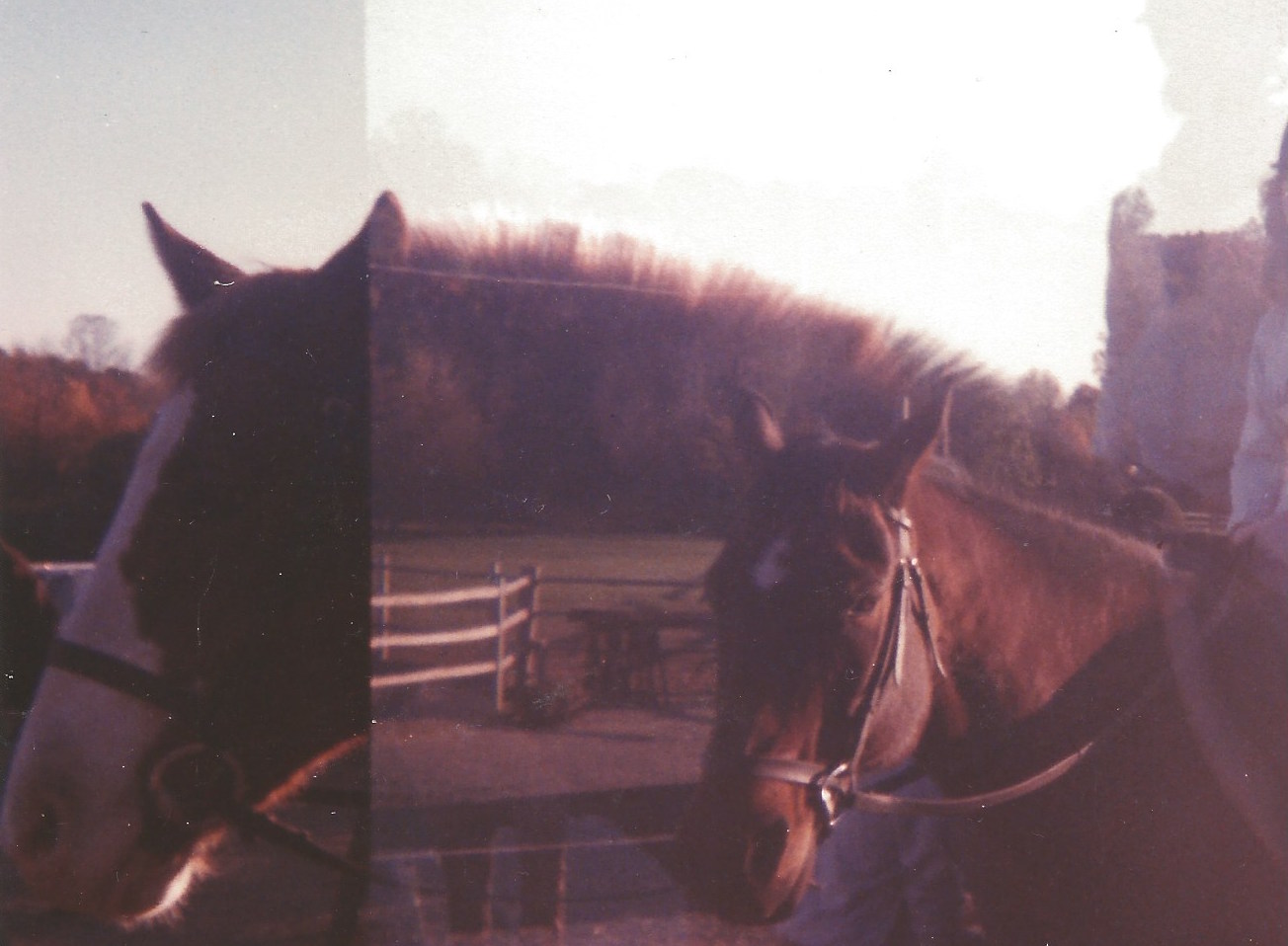
One of the bad but interesting photos: the double exposure makes it look like a great spirit horse decided to join us on the ride. (Photo by R. Gould.)
It didn’t occur to me that I was revising my first draft. (I still kept many of the bad photos because they were all I had or were wrong in the right way. Because sometimes, mistakes[‡] can be cool.)
Side projects, both sweet and hilarious, informed my process. My friends and I decorated clipboards for each other using photos, magazines, stickers, and contact paper. Concepts from collage shaped my scrapbook. How these projects somehow gave me permission to make my own wedding invitations,[§] and how I never questioned that I could do so even though I’d never created cards previously.
(I sketched designs and found instructions on the Internet, and I made every last invite, with half the tools and knowledge I have now. There are a few mistakes, but fewer than I’d guessed there’d be.)
I’m working on new projects, considering re-doing a few old albums with the more modern approach I currently use. I worry if my projects are too conventional, my captions too cute and canned. I’m working up some new phrasing. I’m an editor, after all.[**]
And somehow this proves that even when I’m not writing, there’s this writerly quality to what I do and that I improve, try new things, and find surprising measures of success that sometimes make me amazed that I did what I did. Then, this epiphany clicks: my older writing is just that—older. It’s only a step in the process of becoming a better writer.
What projects inspired your writing or changed how you saw your work? Share your thoughts in the comment section below. Also, sign up for the Sequence’s newsletter to keep current with the latest posts.
[†] Of course, no photos of this long-gone camera exist, which amuses me because I remember it more clearly than some of the events my 110 recorded.
[‡] Mistakes or errors are signposts to success. They point where you need to change direction, learn more, or just try harder.
[§] Permissible but not by my any means sensible. Hating every over-the-top romantic and/or too expensive card that felt very much unlike us also fueled this decision.
[**] I re-read my posts and fix the tiny grammar errors. Yep, editing all the way out the door and to the store.
Defining character means many thing for writers. (“Character” by NY is licensed under CC by 3.0. )
The closing of the year is a jumbled-up affair: The summing up of another year juxtaposed with setting up the next year. It’s not dissimilar to beginning a revision, which I’m (finally) undertaking for a short story I recently wrote. Both processes involve reviewing what you did, what you wish you did differently, and what you will do going forward. And, in both cases, it’s a good time to think about character. Writers use numerous techniques to make their fictional persons feel alive, something that greatly interests me as I edit that first draft where the protagonist feels a bit lacking in, well, character.[*] I recently read two books, one a novel and the other a short story collection, that approach the idea of character in compelling if divergent ways that illustrate what we as writers can really do to with our characters.
Unknowable Versus Lacking Character
A clear sense of character or even lack of character, for example, isn’t necessarily a handicap to tale well told. In The Vegetarian,[†] Yeong-hye rarely speaks throughout the haunting tale that chronicles the manifestation and evolution of her madness. With the exception of an unsettling dream sequence she recounts (presumably to Mr. Cheong), her story, her words, and her life’s details are told through the perspectives of her husband, brother-in-law, and sister. She is in essence a negative presence, and each narrator can only react to her mysteriously changed behavior and/or guess at her actions. We, as readers, experience their bewilderment in tandem. The result is remarkable: Yeong-he, much like roots of her madness (and seemingly, all madness) remain unknowable.
In contrast to her absent presence, Mr. Cheong (Yeong-hye’s husband) defines a lack of character in an altogether different and entirely unpleasant manner. The Vegetarian is not a story for the fainthearted, and Mr. Cheong is clearly the most reprehensible of its denizens—chiefly because he lacks empathy and compassion. The marriage between the two is not a love match: Mr. Cheong aspires to the “middle course”[‡] and finds it “only natural that [he] would marry the most run-of-the mill woman” available (12). Clearly, he represents a certain patriarchal extreme, where marriage means about his needs are being met and indifference to his wife’s interior life, interests, and even mental health. Or, as he puts it, “The strange situation had nothing to do with me” (26). Eventually, her decline, undoubtedly worsened by his neglect and mistreatment, cannot be ignored. Of course, he abandons her; after all:
her expression, which made it seem as though she were a woman of bitter experience, who had suffered many hardships, niggled at my conscience. (38)
Characters at Crossroads
Where loss seems to shatter and/or disrupt the characters of The Vegetarian, characters in the collected stories of If I Loved You, I Would Tell You This frequently find themselves at crossroads in their lives where they struggle to cope with their losses.[§] “Pine”, an exemplary story of the collection, features the widowed Claire who marvels at the choices Heidi made with her kitchen: Claire decides that, were she in Heidi’s shoes,[**] she would have chosen a smaller, easier to navigate kitchen with a pine floor to deaden the clumping gait of the prosthetic leg (155). Claire’s choices unsurprisingly are for muting: when her daughter questions her about her “friendship” with Kevin, she “think[s] about reassuring that no one could ever replace her father for me. I’m sure that is what she’s really asking” (164). It’s not. Alyssa suspects that Kevin has feelings for her mother and, in insisting Kevin is welcome to attend her soccer game, is assuring her mother that she’s okay with Claire moving forward. Claire instead focuses on how soon she will be losing her daughter to adulthood (165) and keeping Kevin as her “yes-man”—or more accurately, her emotional crutch that prevents her from moving past her widowhood (158-9, 172-3). Both Heidi and Claire have suffered terrible losses due to cancer. Their approach to these losses comes down to character: Heidi eventually found within herself the grit to get on with her life, while Claire (for now) remains exactly where she stood when Joe died.
Defining Character
Character, as Merriam-Webster has kindly reminded me, is complex word that refers to more than persons of fictional works. It ranges from alphabetic markings to reputation. It suggests moral make-up of individual as well as the identity of groups.[††] It is word that encompasses much, and you need context to understand which character you happen to be dealing with, whether they lack, morals, or strength. Characters of fiction, too, need that complexity or even that mystery to make them real. As I go forward into the New Year, editing away, I’ll be sure to keep my character’s character and this complexity in mind. And, perhaps, mine as well.
Happy New Year!
Which characters caught your attention in 2016? Tell us about whom and why in the comment section below. Also, sign-up to the Sequences’s newsletter to keep current with the latest posts.
NOTES:
[*] New Year’s resolution #1: take it easy on puns.
[†] Kang, Han. Vegetarian: A Novel; Trans. by Deborah Smith. New York: Hogarth, 2015. Print.
[‡] I’m uncomfortably reminded of the advice that Robinson Crusoe’s father gave him about choosing the “middle state” of life at this moment. (Defoe, Daniel. Robinson Crusoe. New York: Bantam, 1991.)
[§] Black Robin. If I Loved You, I Would Tell You This: Stories. New York, Random House, 2011.
[**] And resolution broken! Amusingly, Claire also considers whether Heidi is “more in denial” about her circumstances (155). [††] “Character.” Merriam-Webster.com. Merriam-Webster, n.d. Web. 29 Dec. 2016.
The ruiners of Christmas are all about wish fulfillment. Just not yours.
For the last several years, my husband and I have hosted the Christmas Day festivities.[*] When we’re finally alone and things have been cleared away enough for now, we kick off our own holiday celebration by watching The Ref. After weeks of holiday hustling and making the feast festive, we’re ready for a grittier Christmas tale.[†]
And there’s nothing quite like watching the holidays go a bit off the rail.[‡]
You see, Christmas stories can’t seem but to help ending well.[§] The question is really how does everything go wrong and then get righted. Because most stories about Christmas tend to capture our anxiety about making the holidays perfect—the just-so gifts, the traditions warmly observed, the delicious spread, the making of new, joyous memories—in contrast to the more likely realities of working late on/through holidays, indifferent gravies, suspect presents, and cranky kids. Christmas isn’t going to be perfect.
But in Christmas stories, there’s at least someone to blame.
Enter the villains of Christmas, the wicked and nasty folks who won’t let the rest of us have our fun. In sharp contrast to our real lives, the rotten are readily reformed—or at the very least, they are thwarted. Some are one-dimensional characters, really more plot devices than people (the Grinch). We delight in their nastiness and cheer for their comeuppance (the thieves from Home Alone). For more complicated characters, writers have the trick job of convincing us that these characters can be cruel while remaining capable of recognizing that they are the problem (Scrooge). We’ve got to believe they can see the world through other people’s perspectives.
And that may well be the ultimate fantasy fulfilled by the Christmas tale—the gift of understanding. We witness the remorseful father who accepts a child for whom that child actually is (Rudolph, the Red-Nosed Reindeer), the miserly bosses who finally understand how their workers truly need funds (A Christmas Carol, National Lampoon’s Christmas Vacation), and the green men who finally get holidays are bit more than consumerism (How the Grinch Stole Christmas!). However cheesily and unrealistically, we are filled with hope. Perhaps we, too, can find a way to open our own hearts and understand or make ourselves understandable to others.
Or at least thwart those who won’t be nice.
Happy Holidays! And be good to each other.
Who is your favorite Christmas villain and why? Post in the comment section below! Also, sign-up to the Sequence’s newsletter to keep current with the latest posts.
NOTES:
[*] This is meant to be a lighthearted holiday piece. If you are among those for whom the holidays are a difficult time and are reaching a crisis point, please seek help. You are valuable. For more support, check out https://psychcentral.com/lib/telephone-hotlines-and-help-lines/.
[†] To be honest, there’s a small part of me that identifies with the Grinch railing about all the “NOISE, NOISE, NOISE” of the holidays, all of which deserves a few humbugs.
[‡] Or, rather a lot, in the case of The Ref. Larceny, divorce, and blackmail aren’t your typical holiday tropes.
[§] Except, I’m told, the movie Krampus. But it is mostly comedy/horror film, so it’s not exactly in the standard Christmas genre.
“And that recommendation, with the exaggerated estimate of ability with which he prefaced it was, if you will believe me, Watson, the very first thing which ever made me feel that a profession might be made out of what had up to that time been the merest hobby.”
Sherlock Holmes, from “The ‘Gloria Scott’” by Sir Arthur Conan Doyle[*]
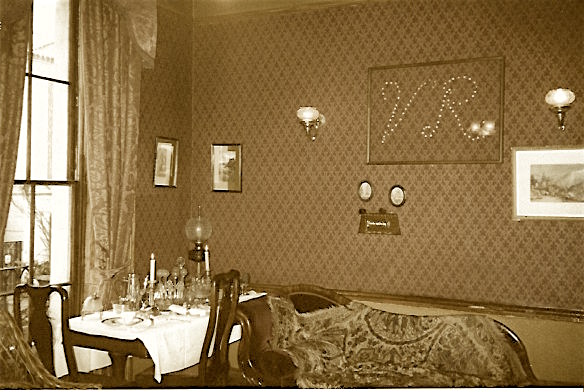
Sir Arthur Conan Doyle’s famous character, Sherlock Holmes looms large in detective fiction. Although he is based on Edgar Allan Poe’s C. Auguste Dupin,[†] Conan Doyle wrote far more extensively about his characters. As a result, Holmes’s personality is developed to a greater degree. He has quirks—Holmes, often described as an eccentric, once shot “a patriotic V. R.” in his sitting room wall (“The Mustgrave Ritual”)[‡]—as well as vices (cocaine use) and hobbies. Of these, I find how authors of fiction use hobbies in their stories particularly interesting because hobbies represent a versatile means of characterization that can make a character more complex or succinctly communicate certain ideas about the character—almost like shorthand—that inform character behavior and even the narrative itself. In this first essay of a series that explores how writers use hobbies in fiction, I will discuss how Conan Doyle judiciously gave Holmes certain hobbies to create his great detective.
“The Merest Hobby”
Sherlock Holmes’s sitting room (as reproduced by The Sherlock Holmes’s Museum) featuring “the patriotic V.R.”. Photo taken by R. Gould.
Conan Doyle uses hobbies to accomplish much in the Holmes stories. For example, we learn that Holmes is talented violinist in A Study in Scarlet. Mentioned alongside his other pursuits, this hobby demonstrates the diversity of Holmes’s interests. Arguably, the violin also gives him an emotional outlet: Watson speculates that the strange violin solos may reflect Holmes’s moods. While such descriptions suggest Holmes’s complexity, there are three instances in which Conan Doyle actually uses the word hobby[§] that illustrate more about Holmes’s character and his profession.
In his first case (“The “Gloria Scott’”), Holmes describes his “habits of observation and inference” as “the merest hobby”. This opinion alters once Mr. Trevor, staggered by how much Holmes could infer about a stranger by mere observation, informs him “that all the detectives in fact and fiction would be children in your hand. That’s your line of life, sir.…” Devoted readers of Holmes know from The Sign of Four, published prior to this story, that Holmes considers observation and deduction to be “two out of the three qualities necessary for the ideal detective”. Rather than informing the reader about detecting, Conan Doyle inserts this epiphany to show both Holmes’s backstory (How did Holmes become a detective?) and his evolution. The younger Holmes, like so many others, once was clueless about his future after he finished college. But as Holmes matures, so does his hobby. “The merest hobby” proves to be the basis of Holmes’s career in disguise.
The Dilettante’s Hobby
But the idea that observation and deduction could be a “mere hobby” is an important consideration that Conan Doyle explores in a second instance where the word hobby appears. “The Greek Interpreter” introduces Mycroft Holmes, Sherlock’s elder brother, who apparently surpasses his younger sibling in these qualities. However, as Sherlock drily observes, “If the art of the detective began and ended with reasoning from an armchair, my brother would be the greatest criminal agent that ever lived”. Since Mycroft Holmes is a lazy man, both lacking the interest in confirming his theories and incapable of obtaining proof to support them, Sherlock dismisses his brother’s efforts as “the merest hobby of a dilettante”.
But Mycroft’s passivity allows him to act as Sherlock’s foil (i.e., the hobbyist versus the careerist) in another manner, as his aversion to exercise is contrasted to Sherlock’s energy. Clearly, Conan Doyle considered the physical abilities[**] a sleuth might need, keeping in mind the dangers connected to catching criminals. Hence, he provided Holmes with suitable hobbies that would make him fit to be a detective.[††] In Sherlock’s college days, his athletic interests were boxing and fencing (“The ‘Gloria Scott’”); Watson later describes Sherlock as “an expert singlestick player, boxer and swordsman” (A Study in Scarlet). As is seen with Holmes’s other “mere” hobby, these activities transform from sporting pastimes into useful tools for self-protection and/or subduing dangerous persons. From these examples, we can see that Conan Doyle uses this notion of hobby to delineate the difference between amateurs and professionals by insisting that a true detective needs to be an active investigator, seeking proof of his deductions and capable of handling whatever dangers and difficulties that arise during an investigation.
The Wearisome Hobby
Sherlock Holmes seeking clues.
The importance of seeking proof, however, naturally leads us back to the third quality of the “ideal detective”: knowledge. Holmes mentions to Watson that he (Holmes) has written monographs on tracing footprints and preserving them in plaster of Paris, distinguishing the various types of tobacco,[‡‡] and how different trades affect appearance of the human hand, a conversation he concludes by noting “But I weary you with my hobby.” To understand what Conan Doyle is doing here, we must unpack this scene further. Holmes’s monographs on “technical subjects” result from seeking this knowledge (The Sign of Four). As detailed in “The Mustgrave Ritual”, Holmes spent all his free time studying “all the branches of science that might make [him] more efficient” as a detective once he embarked on his career. And this knowledge (referring specifically to Holmes’s monographs and how they are useful for solving crimes and presenting evidence in court) is of “interest to the scientific detective”—meaning that Conan Doyle views the ideal detective as the scientific one (The Sign of Four).
This discussion of Holmes’s hobby, the writing of academic treatises on said “technical subjects”—what we’d know call forensic sciences—is important because it firmly establishes that Holmes’s detective work is based in a scientific approach. Although Holmes is not an academic, his work is of sufficient merit to be published for scientific community and this confers on him authority.[§§]. And he needs to claim this authority: Although his scientific studies are extensive, they are not attached to a specific degree program (A Study in Scarlet) since forensic sciences were not yet a formalized field of study. Similarly, Holmes is not a government detective, like Lestrade or Villard (the French detective who consulted Holmes and intends to translate his monographs; The Sign of Four). To justify their regard and validate Holmes’s presence at the crime scenes, it’s important to show that he has certain qualifications (observation, deduction and knowledge) that these regular detectives lack. To summarize, Holmes’s academic hobby neatly serves as his detecting credentials.
Conan Doyle’s compelling use of character hobbies serves multiple purposes in the Holmes tales. Beyond the role of providing character description, they define both Holmes and his approach to detective work: methodological observation, analysis and confirmation backed by scientific knowledge. But Holmes’s is not merely an academic or even armchair detective—he also possesses the necessary abilities to gain information, apprehend felons, and defend himself. He essentially is the fictional CSI of the Victorian era. And in this case, hobbies make the Holmes.
Interested in Holmes’s hobbies? Post your thoughts in the comment section below. Also, sign-up to the Sequence’s newletter to keep current with the latest posts.
NOTES:
[*] For my quotes, I indicate the stories in which they appear because page numbers vary among the numerous anthologies, and it’s impractical to presume we’re all looking at the same book. For the record, the anthology I referred to was: Conan Doyle, Sir Arthur. Sherlock Holmes: The Complete Novels and Stories, Volume 1 and 2. 1920. Reprint. New York: Bantam Classics, 2003. Print.
[†] It’s well established that Conan Doyle loosely based Holmes and Watson on Poe’s Dupin and companion/roommate, respectively. For further reading, the reference lists ofHolmes’s Wikipedia page is suggested—Wikipedia articles themselves are not good primary sources!
[‡] Yep, Holmes is that roommate. Also, this episode suggests that Holmes is a decent marksman.
[§] The three instances of the word hobby are discussed in their order of importance to the stories, not in order of story publication. Similarly, discussion of the actual hobbies tends to follow least to most important hobbies.
[**] This is not one of three qualities a detective must possess so much as a useful fourth.
[††] While Holmes’s marksmanship and acting ability are invaluable to his detective work, it’s difficult to term either as a hobby. We do know that Holmes started disguising himself as he grew famous, which—coupled with Holmes antisocial tendencies—signals that he adopted acting for his profession (The Sign of Four). For marksmanship, it’s unclear whether it was a sporting pastime prior to his career or again something he learned for his profession.
[‡‡] This monograph is also mentioned in A Study in Scarlet.
[§§] You could literally state that he doesn’t just know about tobacco ash, he wrote the book on it. Well, the monograph at any rate.











 For unhappy families, however, the potential for tension at the table is extensive. Agatha Christie, a master of the manor house mystery, frequently seats her characters at a formal dining table. Since her mystery novels often involve the murder of a wealthy benefactor to various family members (money and resentment making excellent motivations), mealtimes can be quite intense. The dinner table, being an obliging sort,


 Rita E. Gould: An Artful Sequence of Words